

Charity Supported Catholic Gift Shops: 2026 Guide
Table of Contents
- Why Charity Supported Catholic Gift Shops Matter
- How to Verify Catholic Charity Legitimacy
- Mission-Driven Catholic Brands: What Sets Them Apart
- Top Charity Supported Catholic Gift Shops for 2026
- Gift Selection Guide by Occasion: Baptism, First Communion, Confirmation, and More
- Sustainability and Ethical Sourcing in Catholic Gift Shops
- Frequently Asked Questions
Last Updated: September 28, 2026
Why Charity Supported Catholic Gift Shops Matter
When you buy a baptismal gift, the question is where the money lands. Charity supported catholic gift shops route part of every purchase to organizations working in parishes and communities. This guide covers finding those shops, confirming the charity claim, and matching gifts to sacraments.
Charity supported catholic gift shops direct a portion of revenue to named organizations, most often Catholic Charities or similar parish-linked ministries. You buy a rosary, crucifix, or bracelet, and the shop passes part of that sale to a cause it publicly names.
That distinction matters. Plenty of religious retailers call themselves faith-based without naming where the money goes. The shops worth your attention name the charity, describe the work, and invite you to check.
How to Verify Catholic Charity Legitimacy
Verifying a Catholic charity means confirming three things: the organization is recognized by Church or civil authorities, it publishes financial information, and the retailer's donation claim is specific enough to check. If a shop cannot name the recipient, that is your answer.
Check Official Catholic Directories
Start with the bodies that track Catholic organizations. A diocese maintains a list of approved ministries and charitable arms, and national bishops' conferences publish directories of recognized agencies. If a shop claims to support a charity, that charity should appear in one of these listings.
Don't trust the shop's own description. Search the organization's name directly and confirm it operates as a registered nonprofit or recognized Catholic ministry.
Review Financial Transparency and Impact Reports
Transparency separates real charitable giving from a marketing angle. A trustworthy organization publishes annual reports showing what it received and funded, plus impact summaries describing programs, locations, and outcomes.
For guidance on what charities should disclose, the IRS guidance on tax-exempt organization disclosure explains the reporting standards nonprofits are expected to meet. Catholic Charities agencies in particular publish program-level reporting because they receive both donor funds and public contracts.
When you review a shop's charitable claim, look for specifics. "A portion of proceeds supports Catholic Charities" is a start. "Five dollars from every bracelet supports Catholic Charities food pantry programs in our diocese" is verifiable.
Mission-Driven Catholic Brands: What Sets Them Apart
Mission-driven catholic brands differ from ordinary religious retailers in one measurable way: they can describe the destination of your money without hedging. Three traits show up consistently, and each can be checked before you buy.
Named beneficiaries. The charity is identified by name, not category. "10% supports Catholic Charities" is checkable; "a portion of proceeds supports those in need" is not.
Consistent giving, not campaigns. The donation is built into the standard price, not a limited-time promotion. Campaign giving spikes around Christmas and Lent, then vanishes; a built-in model means a baptism gift bought in July supports the same charity as one bought in December. Look for "every purchase," not "this month."
Product quality that stands on its own. A charitable mission does not excuse weak craftsmanship. The test: would you buy this item at this price if the charity angle did not exist? If not, the mission is doing work the product should be doing. In practice, the gift still has to be something the recipient wears or uses. A bracelet that tarnishes in a month does not honor a First Communion, no matter where the proceeds went.

How to Compare Two Mission-Driven Brands Side by Side
When two shops both claim a charitable mission, the tiebreakers are specific and easy to apply.
Ask for the giving percentage, not just the charity name. "Supports Catholic Charities" tells you the destination; "gives 10% of every sale" tells you the scale. A shop that states both reaches a level of transparency most religious retailers do not.
Check whether the charity is local, national, or international. A parish food pantry in your diocese has a different impact profile than a national disaster relief fund. Neither is better in the abstract, but knowing which you support helps you match the purchase to your intent.
Look for an annual giving summary. Many mission-driven brands publish a year-end note describing what was given and to whom, the strongest signal that the mission is real rather than a product-page badge. A brand operating for years without one is worth noting.
Check the product details as carefully as the mission details. Metal content, plating thickness, allergen status, sizing, and return policy determine whether the gift is usable. A shop specific about its charity is often specific about its materials too.
What This Looks Like in Practice
A useful example is the sacramental jewelry category. Eleanor June names Catholic Charities as its beneficiary, builds the donation into every purchase rather than running campaigns, and publishes specific product details: 14k gold plating, hypoallergenic construction, lead- and nickel-free materials, and three sizes tied to specific sacraments. That combination is what the three traits look like when all are present.
Adult Sized Miraculous Medal Bracelet →
Top Charity Supported Catholic Gift Shops for 2026
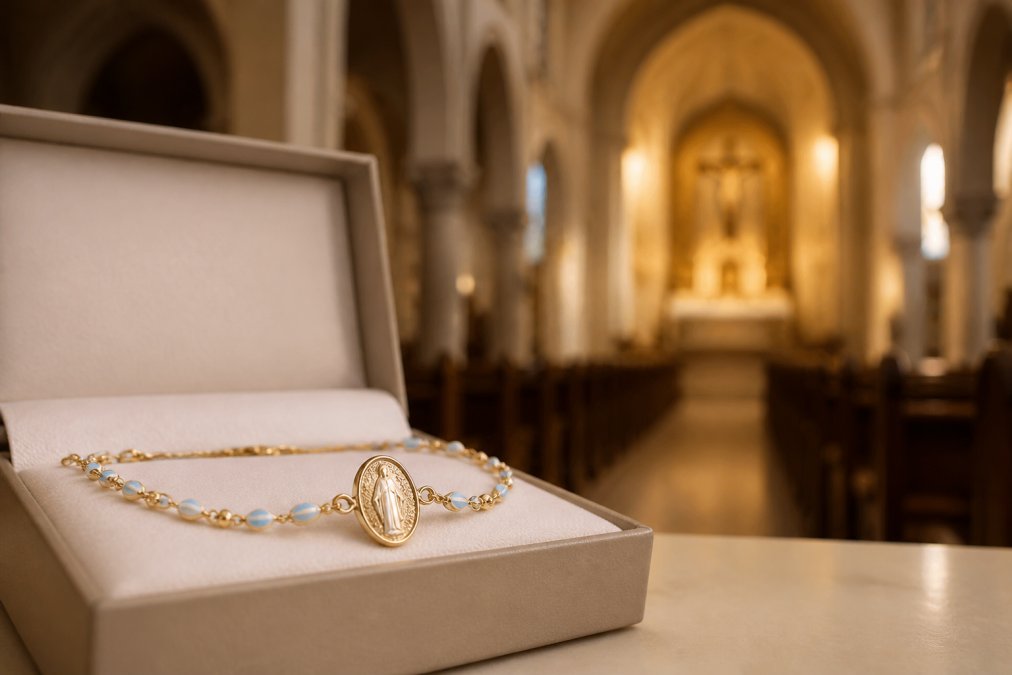
Eleanor June is a jewelry brand whose Miraculous Medal bracelets support Catholic Charities with every purchase. Each piece is gift-boxed and sized for a specific occasion, removing the guesswork from sacramental gifting.

Eleanor June: Miraculous Medal Bracelets That Support Catholic Charities
Eleanor June builds its entire catalog around one design: the Miraculous Medal, paired with a soft pop of color and set on a 14k gold-plated chain. Every purchase supports Catholic Charities.
The collection comes in three sizes, each aimed at a different sacrament.
| Bracelet | Size | Best For | Price |
|---|---|---|---|
| Baptism Bracelet | 4.5" + 1" extender | Infant baptisms, christening gifts | $40 |
| First Communion / Flower Girl Bracelet | 5.5" + 1" extender | First Communion, flower girls | $40 |
| Adult Miraculous Medal Bracelet | 6.5" + 1" extender | Confirmation, weddings, graduation | $40 |
All three are 100% hypoallergenic and free of lead and nickel, which matters for the baby and child sizes in particular. Each arrives gift-boxed.
Other Charity-Linked Catholic Retailers
Beyond dedicated jewelry brands, several categories of retailer route proceeds to Catholic causes, each with trade-offs.
Parish-run gift shops often support the parish directly.
Monastery and abbey shops support the religious community that runs them.
Nonprofit online retailers that fund specific ministries offer the widest selection, carrying everything from Bibles and catechisms to liturgical vestments and church supplies, with a stated percentage going to a named ministry.
Mission-driven jewelry and gift brands sit between the two extremes. They usually name a single beneficiary, build the donation into the standard price, and focus on a narrow product line. Eleanor June is an example in sacramental gifts.
Gift Selection Guide by Occasion: Baptism, First Communion, Confirmation, and More
Matching the gift to the sacrament is the difference between something worn and something stored. Here is how to choose.
Baptism. Choose the smallest size available. A baby bracelet on an extender grows with the child, and hypoallergenic materials matter for infant skin. The Miraculous Medal Baptism Bracelet at $40 is built for this.
First Communion. This is the milestone where the recipient is old enough to have an opinion.
Sustainability and Ethical Sourcing in Catholic Gift Shops
Ethical sourcing in religious retail comes down to two questions: what the product is made of, and who made it. Catholic social teaching has a long tradition of concern for both, making this a natural fit rather than a marketing add-on.
The harder half is labor and supply chain.
Frequently Asked Questions
How can I verify if a Catholic gift shop is charity-supported?
Check the shop's website for a clear statement about which charities it supports and what percentage of profits goes to them. Look for links to the charity's official site, annual reports, or impact summaries. You can also search the charity's name in the IRS Tax Exempt Organization Search or GuideStar to confirm its legitimacy. Legitimate charity-supported Catholic gift shops, such as Eleanor June, openly share their charitable partnerships and provide transparency about their donations.
What is the difference between a commercial Catholic store and a charity-run shop?
A commercial Catholic store operates primarily for profit, while a charity-run shop directs a significant portion of its proceeds to charitable causes. Charity-run shops often have a mission-driven focus, such as supporting Catholic Charities or local parish programs. They may also provide impact reports showing how funds are used. Commercial stores may still donate occasionally, but the charity-run model integrates giving into every purchase.
Are donations to Catholic gift shops tax-deductible?
Generally, no. When you purchase an item from a charity-supported gift shop, you receive a product in return, so the amount is not considered a charitable donation for tax purposes. However, if the shop offers a separate donation option with no goods or services in return, that portion may be tax-deductible. Always consult a tax advisor for specific guidance.
How do mission-driven Catholic brands like Eleanor June support charitable causes?
Mission-driven Catholic brands like Eleanor June integrate charitable giving into their business model. For example, every purchase from Eleanor June directly supports the vital work of Catholic Charities. This means that when you buy a Miraculous Medal bracelet for a Baptism or First Communion, you are also contributing to a greater cause. The brand's commitment is transparent, and customers can feel confident that their purchase makes a difference.
What should I look for in a charity-supported Catholic gift shop to ensure ethical sourcing?
Look for shops that provide details about their supply chain, such as where materials are sourced and how products are made.